
How Selma Residents Come Into View
Every Selma resident lookup starts with a question. A parcel number points to the Assessor. An owner on a deed points to the Recorder. Since January 1, 2025, the county no longer offers open address-to-APN matching. A street address alone may not reach a parcel. Voter rolls run through California My Voter Status. It confirms your own registration after identity matching, not a browsable street roster. That is the sorting a Selma residents directory search does. Fresno Superior Court indexes parties and case status. Vital-record custodians separate informational copies from authorized certified ones.
Older names live at the Genealogy & Local History Library. Its shelves hold Polk county directories and selected Selma, Kingsburg, and Fowler books. There are Haines criss-cross volumes, newspapers, yearbooks, maps, and Great Registers too. A present owner, a listed occupant, a registered voter, and a directory entry can differ. Each one may name a different person. Treat each as a dated clue. No single record proves residence.
For a focused start, move from the broadest useful key to the narrowest record:
- Write down the full name, middle initial, former address, spouse, another personal clue, or known APN already in hand.
- Use the county property and deed sources for parcel, owner, mailing, transfer, and legal-description leads.
- Use California status, court, vital, business, or professional-license sources only for the question each one can answer.
- Use the library shelf, newspaper, yearbook, or Great Register when the search crosses into Selma history.
- Ask Selma City Hall or the record custodian for a specific nonexempt item when a portal stops short.
Note: A negative search can reflect a spelling, coverage, confidentiality, or digitization gap rather than a person who never lived in Selma.
Selma's Public Records Desks
Selma's records split between two desks. City Hall holds the municipal side. County offices in Fresno hold the rest. The Selma City Clerk contact and records page accepts a California Public Records Act request through a web form, an email to cityclerk@cityofselma.com, or mail to 1710 Tucker Street, Selma, CA 93662. City Hall lists weekday hours from 8:00 a.m. to 5:00 p.m. and the main number 559-891-2200. A precise request helps, so name an address, APN, permit, license, code matter, meeting body, or date range.
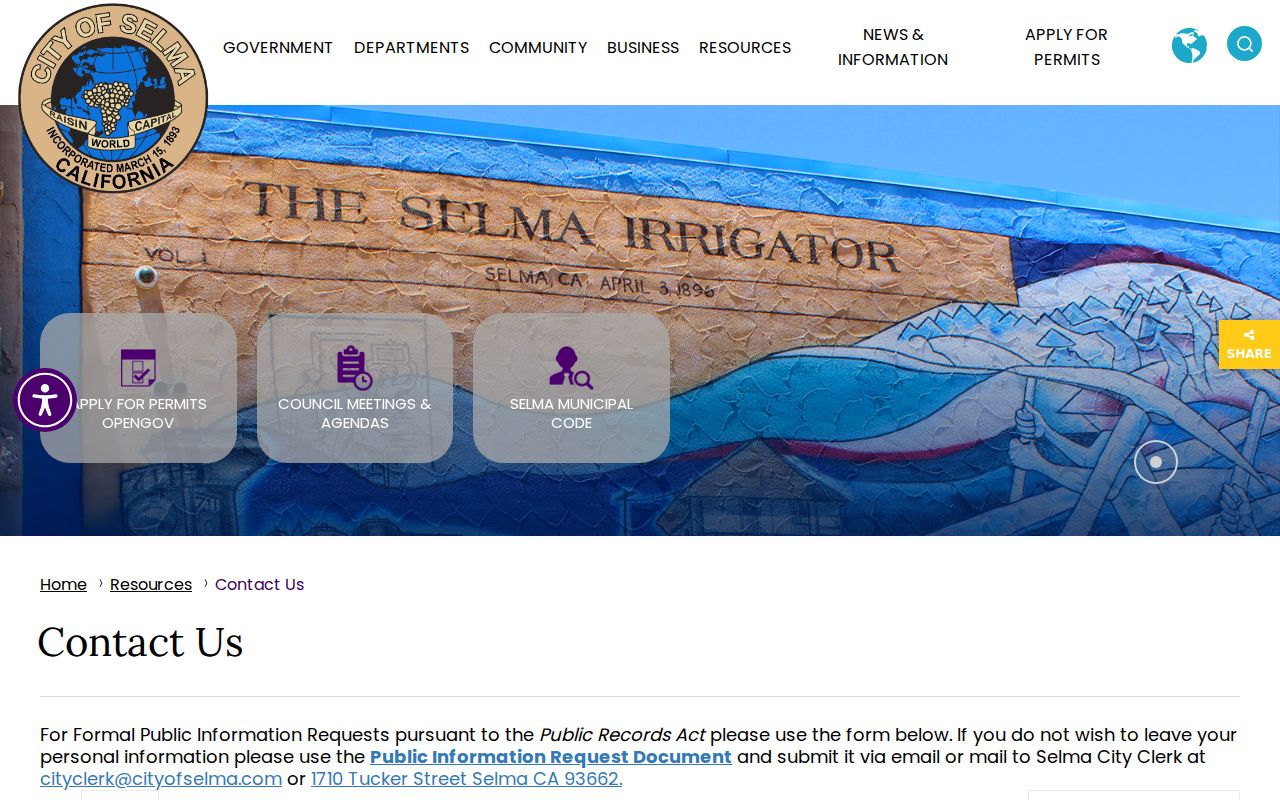
The city contact page stays true to its job. It routes records requests and lists staff contacts without turning a municipal employee list into a general Selma resident list. County records answer different questions. The Fresno Recorder holds deeds, liens, maps, public marriage certificates, and other recorded instruments. The Assessor keeps assessment and roll products. The court holds case records, and the state supplies identity-gated or professional sources. Each office sets its own access rule. So treat the Selma residents directory as a map of custodians.
Selma City Clerk
1710 Tucker Street
Selma, CA 93662
559-891-2200
CPRA requests and staff directory
Fresno County Recorder
1250 Van Ness Avenue
Fresno, CA 93721
Property line 559-600-3471
Fresno County Assessor
Hall of Records, 2281 Tulare Street, Room 201
Fresno, CA 93721
559-600-3534
Assessor services and roll products
California Voter Status
Identity-gated personal lookup
Not a public resident list
Use the state portal
My Voter Status
Selma City Hall's Records Request Route
City records list names without proving occupancy. An applicant, owner, contractor, representative, or business contact can appear without ever living at the property. Community Development brings Building, Planning, and Economic Development together. Planning records run wide. They can involve General Plan amendments, zone changes, conditional-use permits, variances, parcel and tract maps, annexations, site plans, home-occupation permits, signs, and landscape reviews. The Planning Department publishes 559-891-2209 and a virtual counter. Building handles construction permits, inspections, unsafe structures, and abatement.
The Selma OpenGov application portal can submit, track, and manage permits, planning matters, and business licenses. It offers no unauthenticated historical search with stable result fields or coverage dates. Use the web form or the counter when a record needs a date range, parcel, or address match. Police reports follow a separate route. That desk sits at 2055 Third Street, 559-891-2231, and release eligibility depends on the requester's role in the incident.
Selma business-license inquiries ask for a name, business name, email, and nature of inquiry. The Selma business-license information page explains the local requirement. Optional fields include phone, address, and attachments. The contractor form goes deeper. It asks for business and mailing details, owner contact, entity type, contractor number, expiration, classification, work description, workers' compensation, and signature. A license ties a person or entity to local activity, but it does not become a residents directory entry or establish a home address.
Selma Assessor Records After 2025
The Assessor is the property lead. For a Selma address, its current limits matter. Effective January 1, 2025, the county ended open address-to-APN and APN-to-address matching online. Owner-name search is not an unrestricted public web mode. A researcher may need a known APN, a legal description, a parcel map, a counter visit, a purchased roll, or a precise records request. The county's mapping guidance explains how APNs relate to deeds, plats, and parcel maps.
The old embedded lookup still documents its fields. Working from a known parcel, you may see APN book, APN page, APN block or parcel, street number, direction, street name, and a city choice such as Selma. Those fields are descriptive only. The county's notice controls what the tools return. The county GIS map remains the practical bridge while the reverse-address route is closed.
The Fresno County Assessor service page is the official starting point for current notices and roll products:
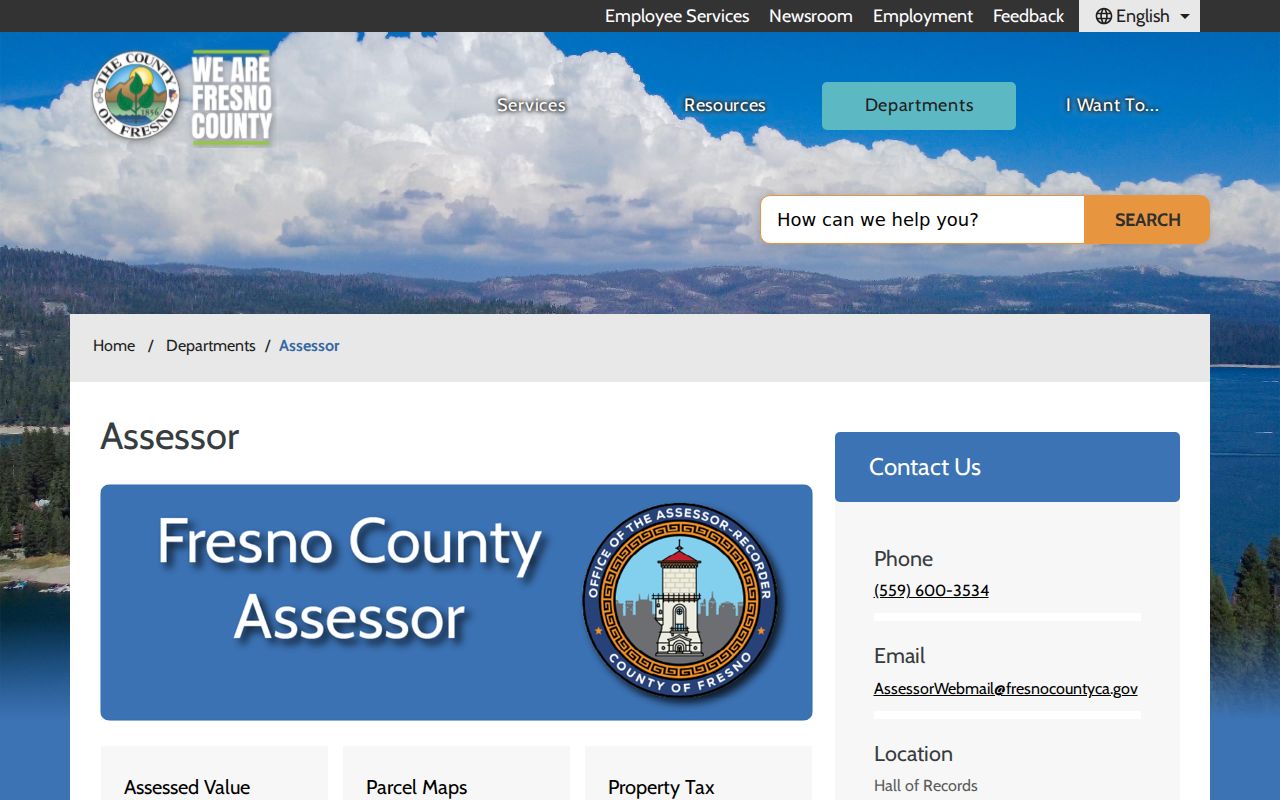
A reverse address match is not the only path forward. When one is unavailable, work from a known APN, a parcel map, the counter, or a purchased product instead.
| Field or key | What it means in Selma work |
|---|---|
| APN book, page, block or parcel | County parcel key; APNs can change after a split, merge, survey, or map renumbering. |
| Street number, direction, street name, city | Visible legacy address fields, not a current open reverse-address guarantee. |
| Assessee and mailing address | Assessment responsibility and tax-mail destination; mailing can differ from the property situs. |
| Land, improvement, and tax-year values | Assessment facts, not a direct finding about who sleeps at the address. |
Note: Fresno will not sell only a Selma slice of the assessment file, so whole-county roll products and filtering may be required.
Present-Day Selma Resident Sources
None of today's records behaves like a true Selma residents directory. A deed names the parties to an instrument. An assessment roll names an assessee. It may also carry a mailing address, but only through a permitted channel. A voter status result goes only to the person who clears the identity check. A staff directory covers public employees in their official roles, while business and license filings show an entity, agent, licensee, or professional contact. Folded together into a roster of a ZIP code or a Selma street, though, every one of these records would be overstated.
| Source | Person or address clue | Custodian | Access path |
|---|---|---|---|
| Assessment and roll products | Assessee, situs or mailing lead, value | Fresno County Assessor | Value page, counter, or purchased roll |
| Official records index | Grantor, grantee, date, document, legal description | Fresno County Recorder | Online index, counter, mail, paid copies |
| California voter status | One person’s registration status | Secretary of State | Identity-gated self-lookup |
| City staff directory | Official name, role, email, phone | Selma City Clerk | Free city contact page |
| Business and license files | Entity, agent, license status, business address | California SOS, DCA, Fresno Clerk, Selma | Search portals and agency requests |
For one person, start with the strongest fact you know. Then confirm it with an independent custodian. That is the Selma resident lookup method in a nutshell. A whole street calls for a different approach. Use the address-side Selma street directory workflow instead. Keeping the two paths apart matters. It stops a business filing or an owner's mailing address from passing as occupancy.
Selma Voter Records Are Personal
California My Voter Status is a self-lookup that asks you to match your own identity details. It confirms one registration. It was never built for browsing a Selma block. Elections Code §2194 limits voter-file access to election, scholarly, journalistic, political, and governmental purposes. The statewide application demands an applicant or organization, a data purpose, geography, security commitments, breach cooperation, and a penalty-of-perjury signature, and personal, private, commercial, solicitation, or harassment uses simply do not qualify.
An approved file can include registration county, name, residence or mailing information where present, status, party, language, precinct, districts, and participation history. The registration date appears as well. Signatures and driver-license or state-ID data stay out. So do the last four digits of a Social Security number, unique identifiers, confidential voters, and preregistered minors. Participation shows a ballot was cast. It never reveals choices.
For an eligible purpose, the state voter-file request information page is the right channel. California's Safe at Home program gives eligible participants a confidential registration route. A status result is one dated evidence point. It is not a complete resident directory. Nor is it proof of current physical presence in Selma.
The California My Voter Status form shows how personal the lookup is:
That identity gate is the access rule itself.
Selma Recorder Records Before 1981
The Fresno Recorder's official-record portal offers an electronic searchable index. It runs from January 1, 1981 to the present. Anything older takes manual work. Scanned grantor and grantee deed indexes run from 1856 to 1913. Separate paper-book indexes for each side span 1914 to 1971. Combined grantor-grantee scans cover 1972 through 1980. None of the old pages supports full-text search. A researcher picks a year band and a surname letter. The researcher notes the book, page, and year, then requests the instrument.
Modern searches can filter by party name, recording date, document number, document type, and APN. APN filtering applies when one appears. The county recommends Last name, First name for the strongest result. Online sessions can end in a cart and download workflow. In-office visitors use the Eagle Recording Kiosk. Copies come online, by mail, or at the counter. The published schedule charges $1.50 for the first page. Each added page costs $0.50, and certification is $1. A card payment at the counter adds $2.50. Certified copies travel by mail because they need a live signature and seal.
The Recorder keeps no single property file per address. Each deed, lien, reconveyance, map, or judgment stands as its own instrument, indexed by party. Start from an acquisition deed. Identify the grantor, then hunt that person or entity as an earlier grantee. The Fresno Official Records Search and Copies portal is the online doorway. The 1250 Van Ness Avenue counter, mail requests, and phone lines still serve as fallbacks.
Selma's Historical Directory Shelf
The Fresno County Public Library's Selma Branch, at 2200 Selma Street, holds the system's second-largest local-history collection. Remodeling has shifted access. A Tuesday pop-up runs 11:30 a.m. to 1:00 p.m. in the Selma Police Headquarters Community Room at 2055 Third Street. Serious directory work belongs elsewhere. The Genealogy & Local History Library, at 5769 N. First Street in Fresno, opens Tuesday 10:00 a.m. to 5:00 p.m., Wednesday noon to 7:00 p.m., Thursday and Friday 10:00 a.m. to 5:00 p.m., and Saturday 10:00 a.m. to 2:00 p.m., with appointments available.
The shelves carry directories, newspapers, yearbooks, maps, photographs, oral histories, census material, Great Registers, county vital indexes, and cemetery leads. The named Selma, Kingsburg, and Fowler directory run is intermittent from 1962 through 1991. Countywide Polk coverage is broader. It stretches from 1907 through 1957. Haines criss-cross coverage begins in 1973. Check the Genealogy and Local History collection hub before a trip.
Note: The library’s temporary Selma access matters because microform reader and copying equipment are part of the historical search path.
Selma's residents directory shelf has deep local roots. A WCTU-backed reading room opened in 1888. A Carnegie building followed in 1905. The library became a county branch in August 1913, and that chain of institutions explains why a small railroad and farm town holds a serious research collection rather than a single current volume. Publisher changes matter when choosing a volume, so start with this directory-history record. The collection image comes from the Genealogy and Local History collection hub:
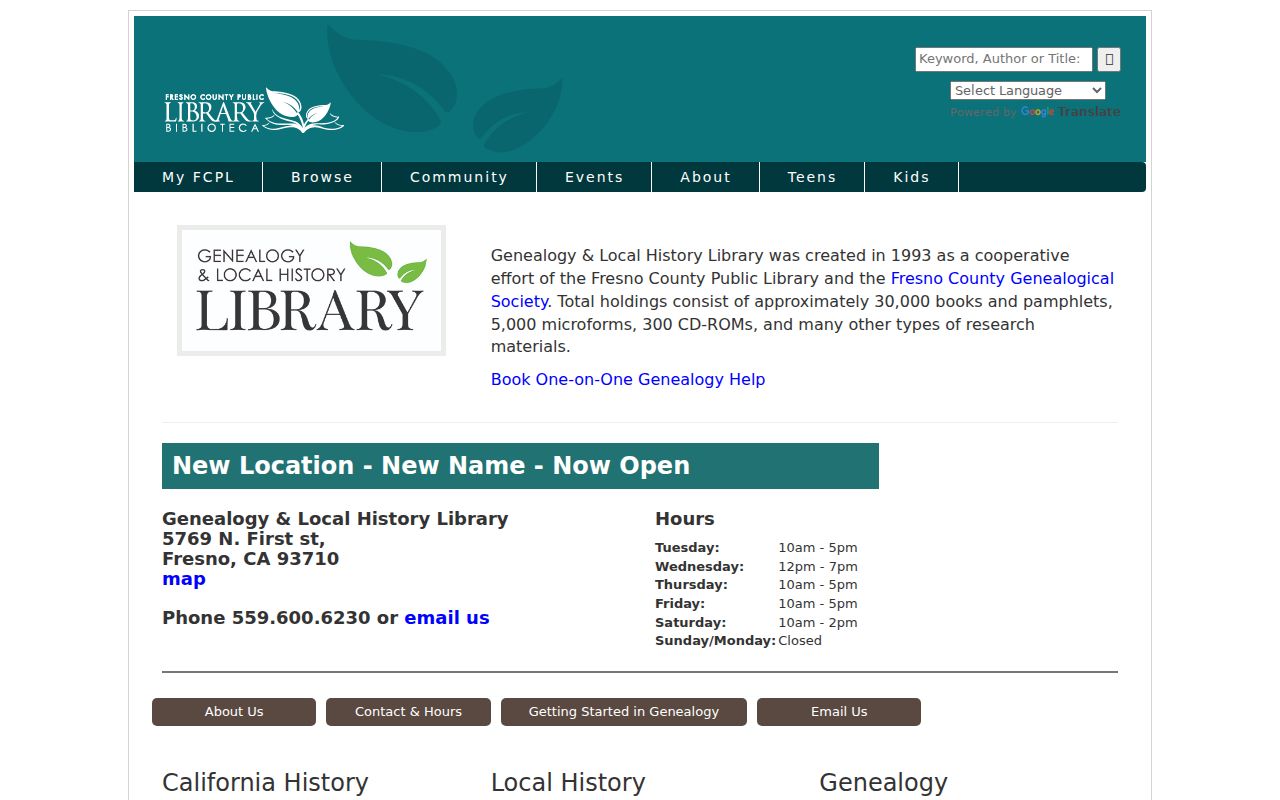
The shelf itself is the authority here. Old names, addresses, and occupation notes can be checked against the original volumes rather than a thin web summary.
Selma Directory Records Speak in Keys
A few key terms keep Selma residents directory work clear. A roll is a dated list kept for one purpose. Assessment and registration rolls each answer their own question. An index points toward an instrument or a case. But it is not the document image itself. A parcel is a county tax unit. A situs address is simply the physical location of the property. A criss-cross directory reverses the usual name-first order. So an address, street, or phone lead can point toward a listed occupant.
- Roll
- A purpose-bound list. An assessment roll records tax facts, not every person at a property.
- Index
- A finding aid for a deed, case, or filing. The source image and certified copy are separate products.
- Parcel
- A mapped county property unit identified by an APN that can change after a split or merge.
- Situs and mailing address
- Situs is where land sits. Mailing is where notices go. They can describe different places.
- Criss-cross directory
- An address-oriented directory used to move from street or phone information toward a named listing.
These definitions prevent one common error. A current owner may receive tax mail somewhere else. Renters may be missing from a directory entry. A court index may carry a name that belongs to another person entirely, and a parcel map can show adjacency without revealing any household. Every clue needs its own date, role, and source.
Selma Lookup Names Need Two Anchors
Same-name records are common in Selma. Multilingual households, compound surnames, initials, and records created in different eras all blur the picture. Preserve the exact spelling each custodian used. Try spaced, hyphenated, concatenated, and shortened forms. A former address, an APN, a spouse, an age band, a business entity, or a case number can separate two people, and never assume ethnicity, family ties, citizenship, or identity from a name alone.
One useful pattern runs name, role, date, second custodian. A business filing can identify an agent. A deed or directory can then test whether that person has a real Selma connection. A court party can be checked against a known address or case date. A directory student can be compared with a later newspaper notice or professional license. An unclaimed-property result is a lead, not an address. The ClaimIt search is free and official. A claim still requires identity proof.
The California Secretary of State business-entity search can supply an official filing anchor:
Entity numbers, filing dates, and agent roles separate names without turning a business record into a home address. The California DCA license search adds another public role:
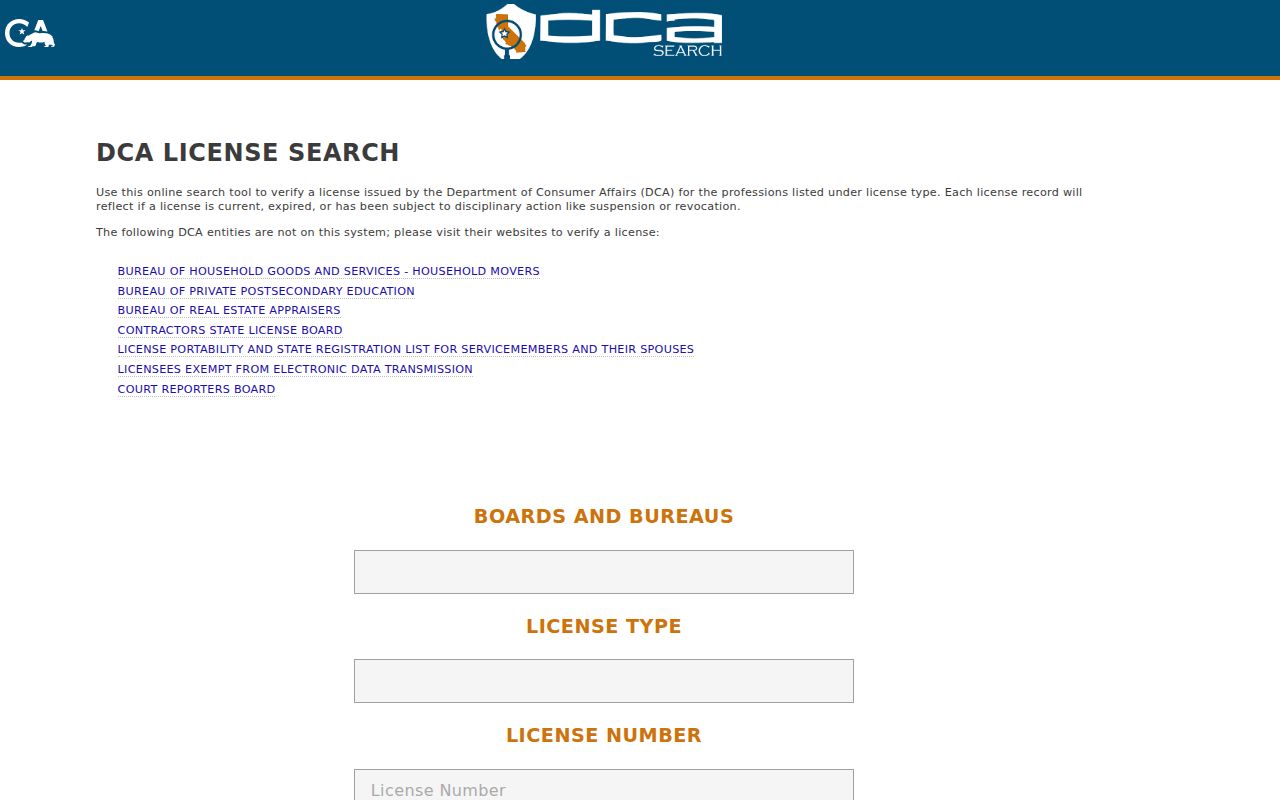
License status and public discipline fields should stay distinct from property, court, and directory evidence. The California unclaimed-property search is another free lead:
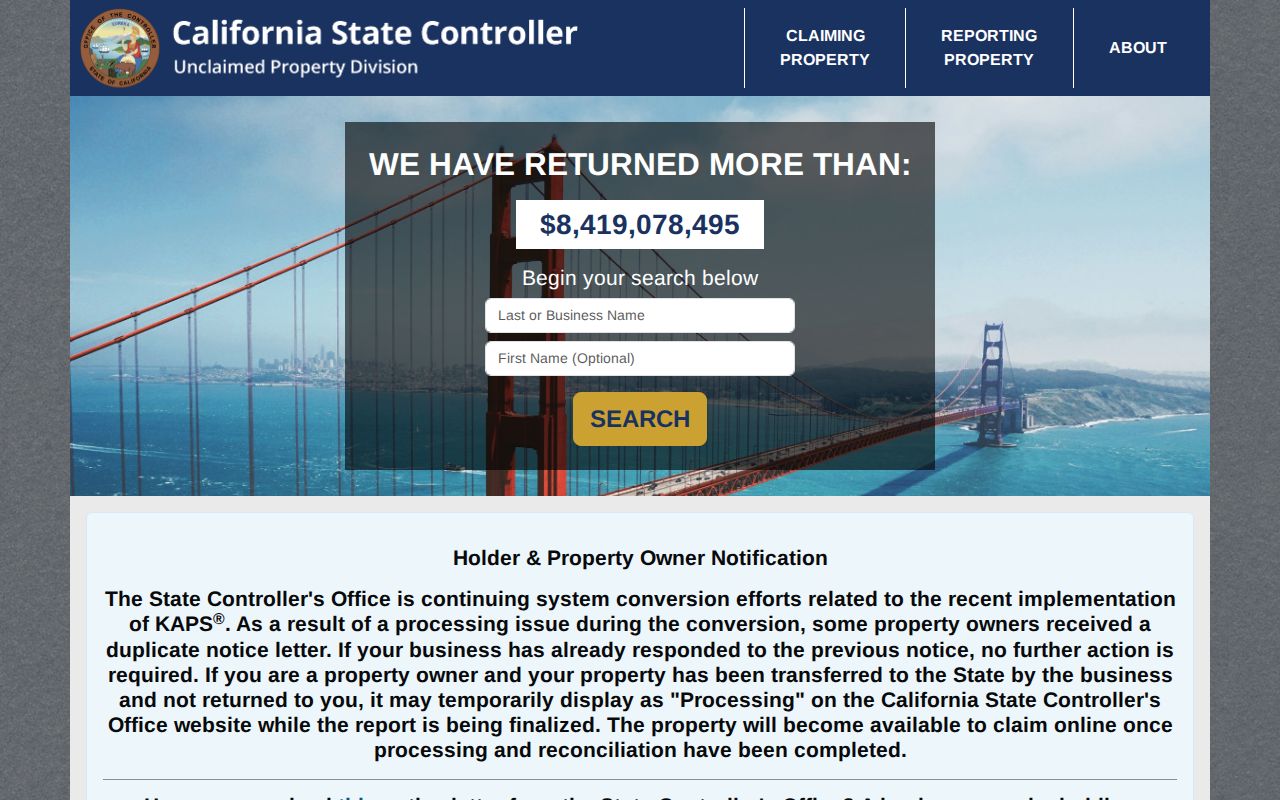
A claim still requires identity proof, not an address.
Use the record for its stated purpose. Selma records support personal history, family research, civic review, and scam avoidance. Do not use a name or address trail to stalk, harass, intimidate, or expose a protected person.
Commercial people-finder products blend public, licensed, and inferred data. They can be stale, costly, or merge two people. None of them replaces a certified copy, a custodian's correction process, or a carefully dated library source for Selma records.
How Selma's Records Trail Changed
Selma's past shapes every search. Settlement at Valley View dates to June 26, 1880, the post office to August 12, 1880, and incorporation to March 15, 1893. The original townsite covered forty acres. The railroad cut across it diagonally. Small lots near the track and larger farm parcels at the edge rarely line up with a modern block search, and Old State Route 99, South Golden State Boulevard, Nebraska Avenue, and 2nd Avenue all create alternate names in the records.
The 1890 census was destroyed. Great Registers fill part of the gap. The 1891 Selma Enterprise run and early Sanborn maps extend the substitute trail, with editions from 1888, 1891, 1901, 1907, 1913, 1923, and a corrected run through 1942. Local papers carry obituaries, announcements, legal notices, clubs, churches, and business changes. The agricultural and railroad setting explains why resident clues sit scattered across business filings, directories, property records, and local news.
Scale changes nothing. A resident directory cannot be inferred from population counts. A street, a ZIP code, a city line, a district, an irrigation area, and a parcel map can overlap without sharing one boundary. Use the specific office, map, or collection that created the evidence. That habit keeps a Selma lookup honest.
The Selma records request page is the public route when an identifiable, nonexempt city record is not online. The California Public Records Act text sets a ten-day disclosability window for agencies. Fourteen more days are possible for defined unusual circumstances. That is a decision window. It is not a production deadline.
Historical Selma Resident Directories
Selma's printed directory history starts with the countywide Polk-Husted and R.L. Polk runs. Those books cover most or all of Fresno County from 1907 through 1957. Several years are missing, though. In 1962 the named Selma, Kingsburg, and Fowler volumes begin. Editions follow in 1965, 1967, 1969, 1971, 1972, 1973, 1975, 1977, 1978, 1980, 1982, 1985, 1986, 1987, 1989, and 1991. Haines criss-cross books then pick the countywide address coverage back up in 1973. For the full shelf-by-shelf story, see the Selma city directory book. Leave current address work to the street directory lookup.
A typical entry lists a name, a spouse convention, an occupation, an address, and sometimes a cross-reference. A criss-cross page works in reverse. It starts from a street or phone number and lands on the listed household. Compare adjacent editions before concluding anyone moved. Publication lag, initials, omitted renters, married-woman conventions, and abbreviations can all mislead. They can make a person seem to vanish from the residents directory when they never left town.
Treat every printed directory as a snapshot. Proof lies in what an edition actually states. A name listed at an address in a given year is the evidence. It does not prove each household member lived there all twelve months. Pair the city directory with a deed, a census page, a newspaper item, a yearbook, a probate file, or another dated record. A deed can anchor a date. A census page can confirm a household. That habit turns the Selma residents directory into a careful trail instead of a guessed roster.