
Selma City Directory Collections on the Shelf
The Genealogy & Local History Library at 5769 N. First Street in Fresno is the principal home for the Selma city directory collections. The library was created in 1993 through Fresno County Public Library and the Fresno County Genealogical Society. It holds about 22,000 books and pamphlets, photographs and postcards, oral histories, and a large vertical file with a Selma heading. The Selma Branch at 2200 Selma Street has the system’s second-largest local-history collection, but remodeling has changed how visitors reach it.
Start with the Fresno library directory history to identify publisher and coverage, then check the exact holding before traveling. Directory years are uneven. A missing year can reflect a publication gap, a run held under a county title, a volume that was not preserved, or a search that used the wrong name form.
| Collection | Years or span | Where held | Access |
|---|---|---|---|
| Countywide Polk-Husted and R.L. Polk | 1907-1957, with gaps | Genealogy & Local History Library | Hard copy and microform; ask staff |
| Selma-Kingsburg-Fowler volumes | Selected years, 1962-1991 | Genealogy & Local History Library | Exact volume list; on-site research |
| Haines criss-cross | From 1973 | Genealogy & Local History Library | Address-oriented coverage |
| Rural telephone directories | 1909 onward, changing runs | Library collections | Subscriber and address clues |
| Selma newspapers | 1891-1912 and 1939-present title history | Library and newspaper holdings | Obituaries, notices, announcements |
The table shows why a Selma city directory search should start with the shelf, not a generic web search. Publisher, year, county boundary, and index style shape what a name means.
Reading a Selma City Directory Entry
A printed city directory usually begins with a name index. A typical entry can include a spouse convention, an occupation, and an address. A criss-cross section reverses the path by street, house number, or phone. The research did not locate an openly viewable Selma page, so exact abbreviation keys, local line breaks, and the fields on one specific entry remain unverified. Read the original scan or volume image when a transcription leaves out a mark.
Directory notation is compact. Initials can stand for a first name. A spouse convention can point to a household relationship without listing every adult. An address can be a business or mailing point. A blank year can mean the family moved, the directory omitted the listing, or the publication did not cover Selma. The entry is a lead to test, not a modern resident lookup result.
- City directory
- A recurring publication that indexes names and often adds address and occupation clues for a place and year.
- Criss-cross directory
- An address-first or phone-first section that helps move from a street clue toward a listed name.
- Household index
- A name or family finding aid. It may represent one listed person rather than everyone who lived at an address.
- Abbreviation key
- The publisher’s explanation of short forms, symbols, spouse conventions, and address marks.
Record the title, publisher, edition year, page, exact name form, address, and any cross-reference. That citation lets a later researcher tell a directory snapshot from a conclusion about a person.
Tracing Selma Families Through City Directories
Use a Selma city directory as a sequence of dated points. The safest route is to hold the name form steady while tracking address, spouse notation, occupation, and nearby households. Pair the directory years with census years, newspapers, Great Registers, deeds, probate, yearbooks, or a later license record. A move between two editions is meaningful, but it does not tell you whether the household owned the property or rented it.
- Write down the person’s full name, initials, spouse convention, address, and the volume citation exactly as printed.
- Check the next available edition and search surname variants, compound surnames, hyphenation, and initials.
- Compare the address with a Sanborn map, deed legal description, newspaper notice, or census-era source.
- Mark each appearance, disappearance, move, and gap without filling an absent year with a guess.
- Confirm the strongest identity clue with a second custodian before joining two similarly named households.
The Selma street directory lookup handles current address-keyed records. The historical city directory method stays focused on a publication-era household trail.
The Three Selma City Directory Eras
Selma’s city directory history falls into three useful periods. Polk-Husted, later R.L. Polk, gives broad Fresno County coverage from 1907 through 1957. The named Selma-Kingsburg-Fowler run begins in 1962 and appears in selected years. Haines criss-cross coverage resumes countywide in 1973 and offers the reverse street view that a name-first directory lacks. Telephone directories add another layer, with county and rural runs changing over time.
Countywide coverage has known gaps, including 1874-1880, 1885-1888, 1897, 1899, 1930, 1943, 1945-1946, and 1948. A gap is not evidence that Selma had no residents. Use newspapers, yearbooks, Sanborns, Great Registers, and maps to bridge it. The named three-city volumes are the most direct way to test a Selma name in the later twentieth century.
The exact three-city years are 1962, 1965, 1967, 1969, 1971, 1972, 1973, 1975, 1977, 1978, 1980, 1982, 1985, 1986, 1987, 1989, and 1991. The gaps between them are part of the research result. Do not turn an intermittent run into a claim of annual coverage.
The collection history image at the library’s directory overview is useful before selecting a year:
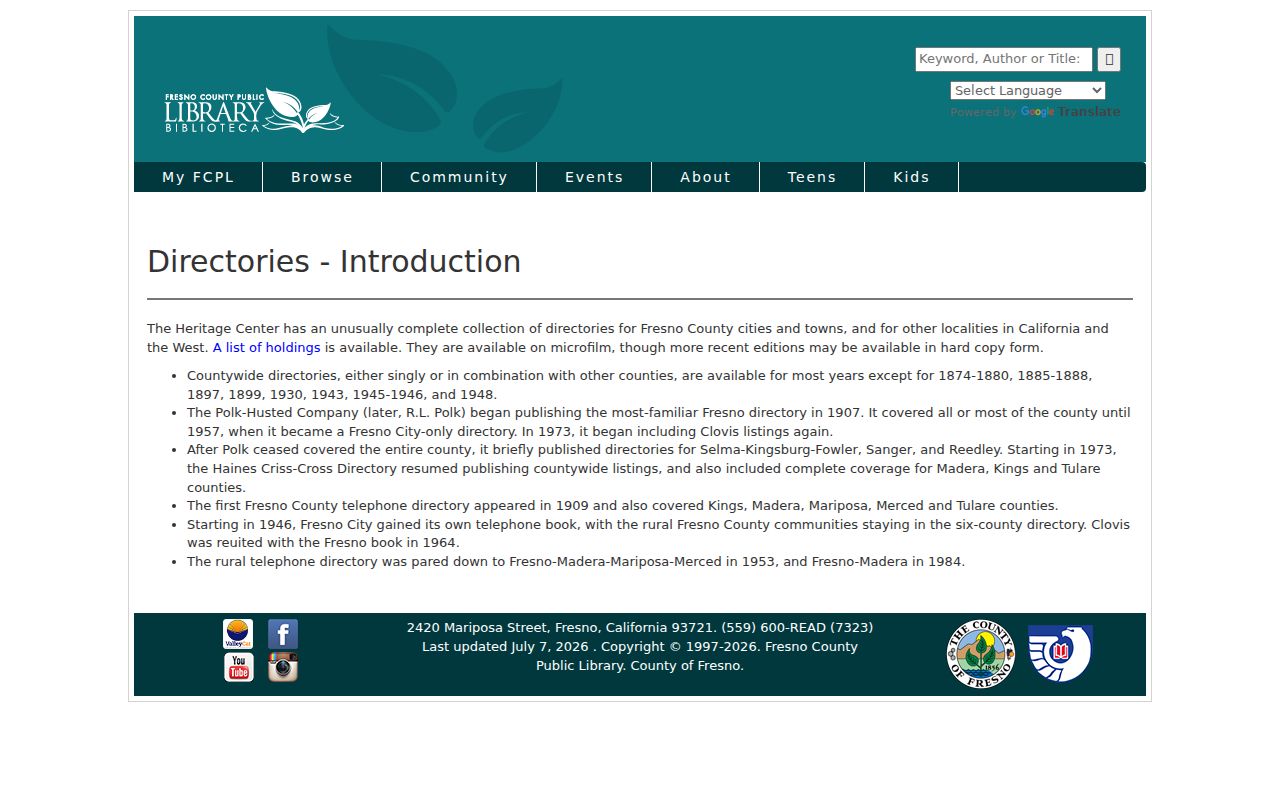
It frames the catalog as a set of publisher eras, which keeps a search from treating every directory title as the same kind of source.
Every Selma-Kingsburg-Fowler Volume
The named three-city city directory is especially valuable because it narrows the search to Selma and nearby communities without pretending to be a complete city roll. The seventeen listed volumes cover selected years from 1962 through 1991. Check the title page and place coverage before assuming a page includes the address or year in question. A volume may use a shared publication name while its index and street section work differently.
Use the exact Selma directory year list to plan the run. Start with a year close to the known event, then move outward to the nearest earlier and later editions. Search both surnames when a family uses a compound name. Preserve accents, spaces, hyphens, initials, and alternate order. The original page matters when OCR drops a character or merges two lines.
If a person is absent, test the most likely explanations: the volume is not one of the covered years, the household moved, the listing uses another name, the person was not listed, or the index image is hard to read. A directory can support a dated address lead. It cannot alone establish continuous residence, kinship, or present status.
The exact Selma directory year list gives the holding image a useful starting point:
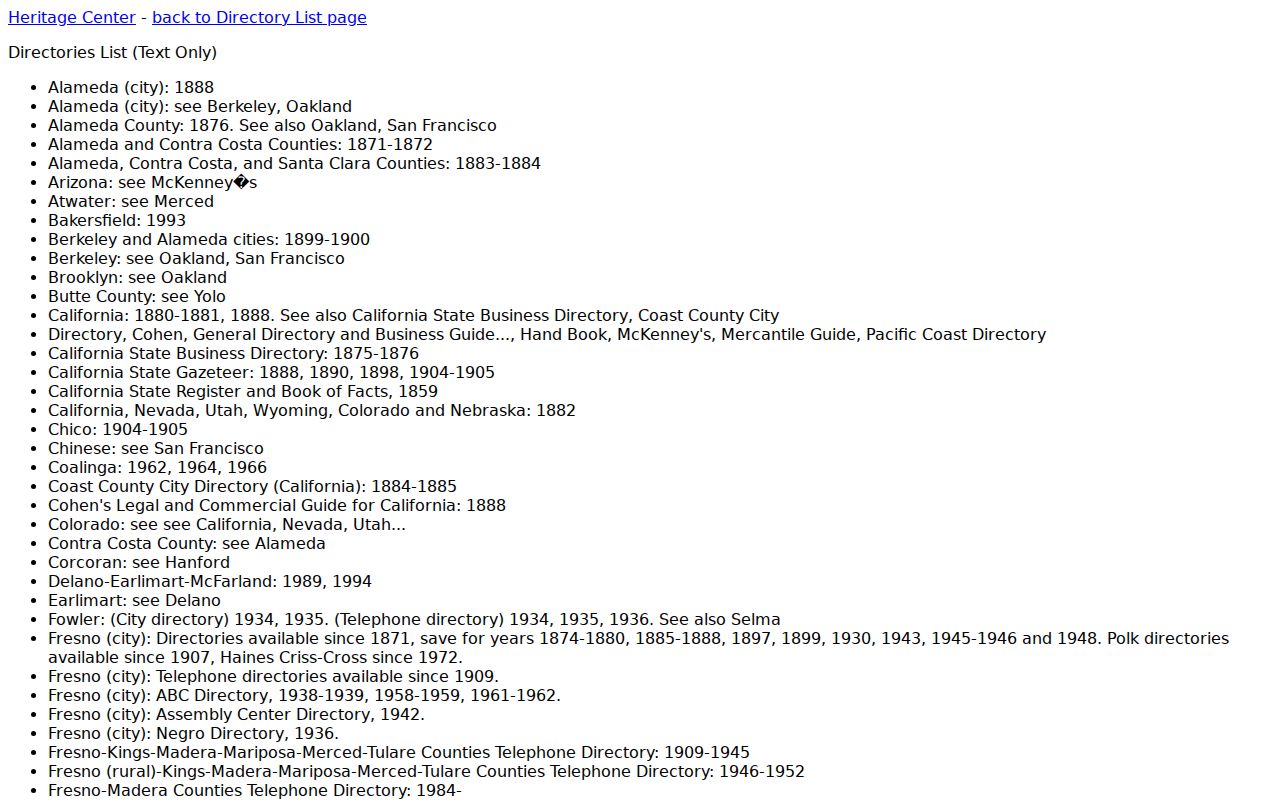
The year list makes the gaps visible, which is often the key to a sound family-history search.
Sanborn Maps Follow Selma Addresses
Sanborn maps are not city directories, but they can test the physical side of a directory clue. Selma holdings include February 1888, April 1891, January 1901, August 1907, April 1913, April 1923, and an April 1923 to April 1942 corrected edition. The maps show building footprints, material, stories, use, street widths, boundaries, and house or block numbers. They help answer whether a structure existed when a directory or newspaper placed a person nearby.
The 1888 and 1891 editions are free color scans through the Library of Congress. Later editions are available through library microfilm. The corrected atlas is layered evidence, not a single date. Paste-ons and corrections may represent changes made over time. Compare the map, street name, block number, and legal description rather than treating one line as an exact address match.
The Selma Sanborn holdings page shows the local run:
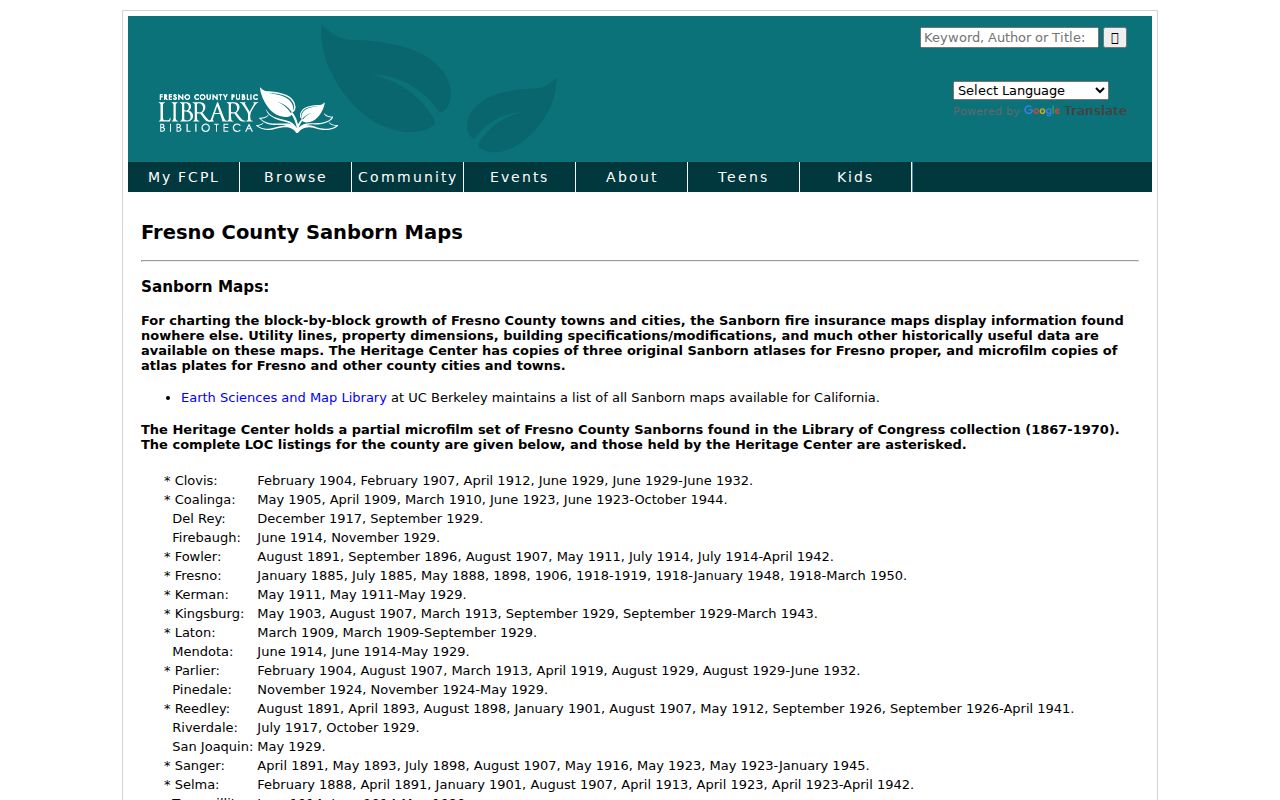
Use the map as a structure check beside the city directory entry, not as a source that names every resident.
Yearbooks and Enterprise Add Living Detail
Magnet yearbooks can catch students and faculty who do not appear in adult city directories. Selma High Magnet holdings include 1910-1913, 1915, 1917, 1919-1920, 1922-1931, 1933, 1937-1949, 1951, 1954-1957, 1963-1966, 1972-1976, and 1992. Search the expected school year, then compare full names, initials, activities, and class context. An absent name can mean a missing volume, a different school path, or a non-graduation year.
Newspaper holdings extend the city directory trail. Fresno County Enterprise microfilm covers October 1891 through September 1912. The Selma Enterprise and Selma Irrigator run from 1939 to 1947, followed by the Selma Enterprise from 1947 to the present. Obituaries, announcements, legal notices, clubs, churches, business changes, and address moves can explain why a directory entry appears or disappears.
The Selma High yearbook holdings are a companion source:
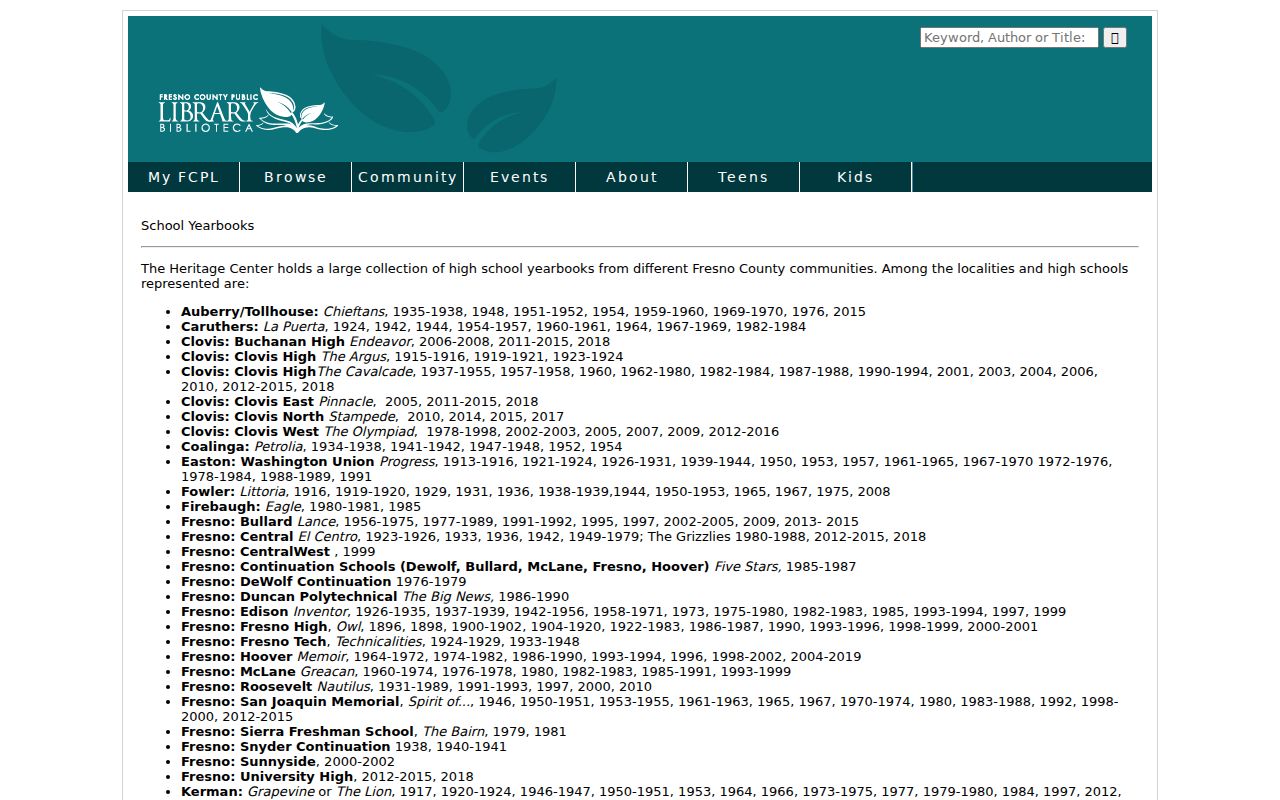
School material adds a human context to a city directory entry without turning a club or class listing into proof of a current address.
The 1890 Census Gap Has Other Sources
The destroyed 1890 census is a famous gap in Selma family history, but it is not a dead end. Fresno County Great Registers cover 1867-1944, with a statewide 1890 index. The 1891 Enterprise microfilm and the 1891 Selma Sanborn map add a newspaper and built-environment view. The library’s census and Great Register holdings explain how those materials can be used together.
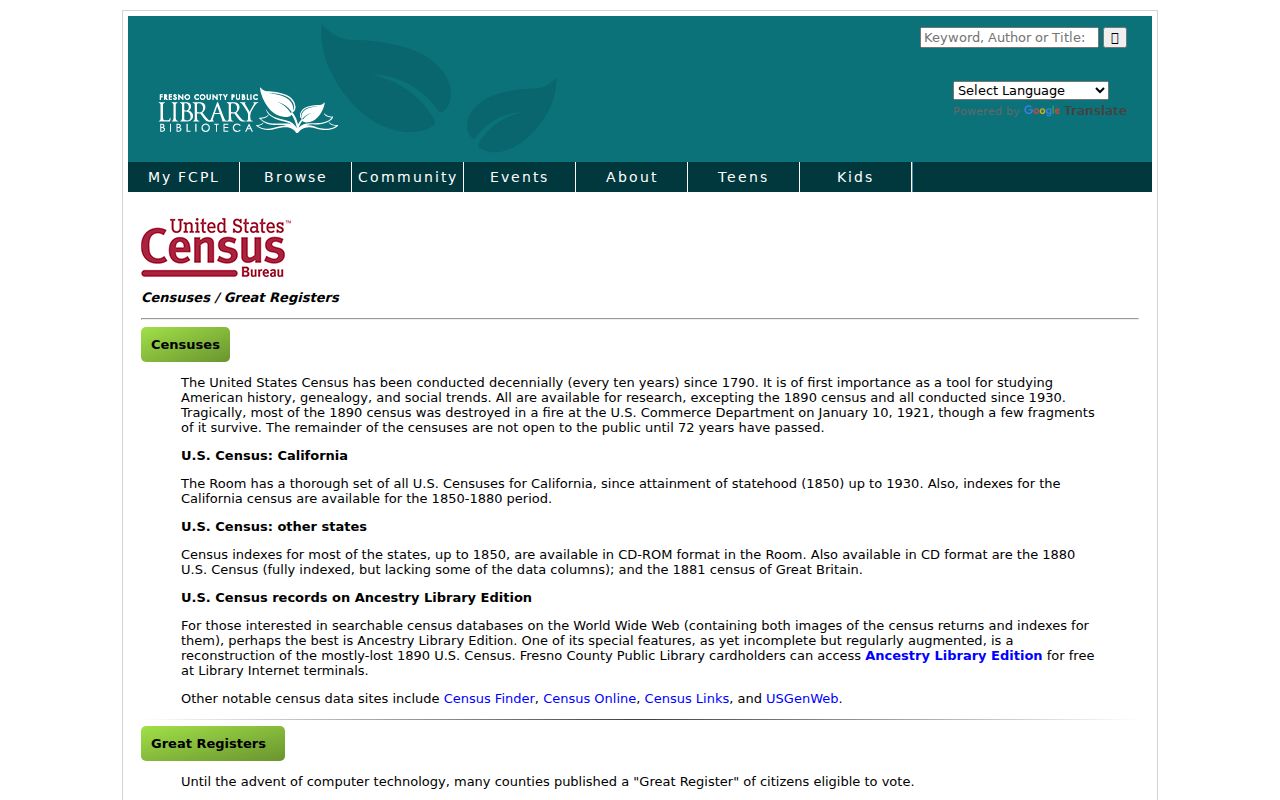
A Great Register can place an eligible voter’s name and location in an era. It does not recreate every household. A Sanborn map can show a building, not its occupants. A newspaper can connect a person to a place, but OCR may miss initials, accents, hyphens, and Spanish compound surnames. Browse the original date when a search result is thin.
Note: A missing census schedule makes source pairing more important, not permission to fill a blank with an assumed household.
From Reading Room to Selma City Directory Shelf
Selma’s local-history network has its own record-keeping story. A WCTU-supported reading room opened in 1888. A $6,000 Carnegie building opened in 1905. The library became a county branch in August 1913 with 2,055 volumes. The Fresno County Centennial Communities history helps anchor the settlement and civic timeline, while another profile gives 1910 for the branch, so the difference should be disclosed rather than quietly merged.
Today, the central Genealogy & Local History Library is the practical research room. Its address is 5769 N. First Street in Fresno, with Tuesday through Saturday hours and appointments. The Selma Branch remodel has shifted local service to a Tuesday 11:30 a.m. to 1:00 p.m. pop-up at the Selma Police Headquarters Community Room. The local collection still matters, but access should be checked before a visit.
The library’s genealogy hub connects the city directory, map, newspaper, yearbook, photograph, oral-history, census, and cemetery layers. The Selma Branch page notes the remodeling and temporary pop-up service, so check local access before relying on a branch visit. That breadth is why an older Selma name can be traced even when a single city directory year is missing.
Using Selma City Directories Carefully
City directories are strongest when they answer a narrow, dated question: was a name listed at an address in this edition, did an address change between two books, or did a street entry point toward a household? They are weaker when asked to prove every resident, a present address, ownership, kinship, or a complete absence. Compare an adjacent edition and a second record before making the identity link.
For current parcel work, use the Selma street directory page’s address chain. For one-person confirmation, use the resident lookup and its court, vital, business, and license distinctions. The city directory remains the historical anchor, with the library’s exact title, year, page, and source image preserved in the research note.